Search.io
Hardening the dashboard, SDK, and storefront plugins around an AI search engine.

Search.io
3
Three surfaces hardened in parallel — the merchant console, the React SDK, and the storefront plugins — each owned by the same embedded team rather than passed between vendors.
Shopify
A single-platform integration grew into Search.io's flagship open-source SDK once the modular architecture made it clear the same library could serve every storefront.
Search.io — formerly Sajari, founded in 2017 and later acquired by Algolia — is an AI-powered search platform that helps online stores grow sales through better product discovery. The technology infers what a shopper is actually looking for, returns results in real time, and is trusted by large businesses worldwide.
We partnered with Search.io across three surfaces at once: the merchant console where businesses tune their search experience, the open-source SDK developers reach for, and the integration plugins that drop Search.io into Shopify and other e-commerce platforms. The brief was reliability over feature velocity — the kind of work that lets a search vendor become the default for an enterprise retailer.
Day-to-day we worked as part of Search.io’s distributed team rather than a vendor across a contract — shared design files in Figma, pull-request reviews in GitHub, Slack for the rest, and joint testing sessions whenever the surfaces met. Less about shipping one big release and more about steady ownership of the shape of the product.
Search.io's engine had to understand a shopper's intent the way a human would and stay fast and available across very different surfaces. Merchants wanted a console where they could tune synonyms and relevance without reading documentation. Developers wanted an SDK they could drop into a React app without re-learning the API every release. Storefronts on Shopify and other platforms wanted a one-click install that updated itself. We took on all three at once so the same team owned the consistency between them.
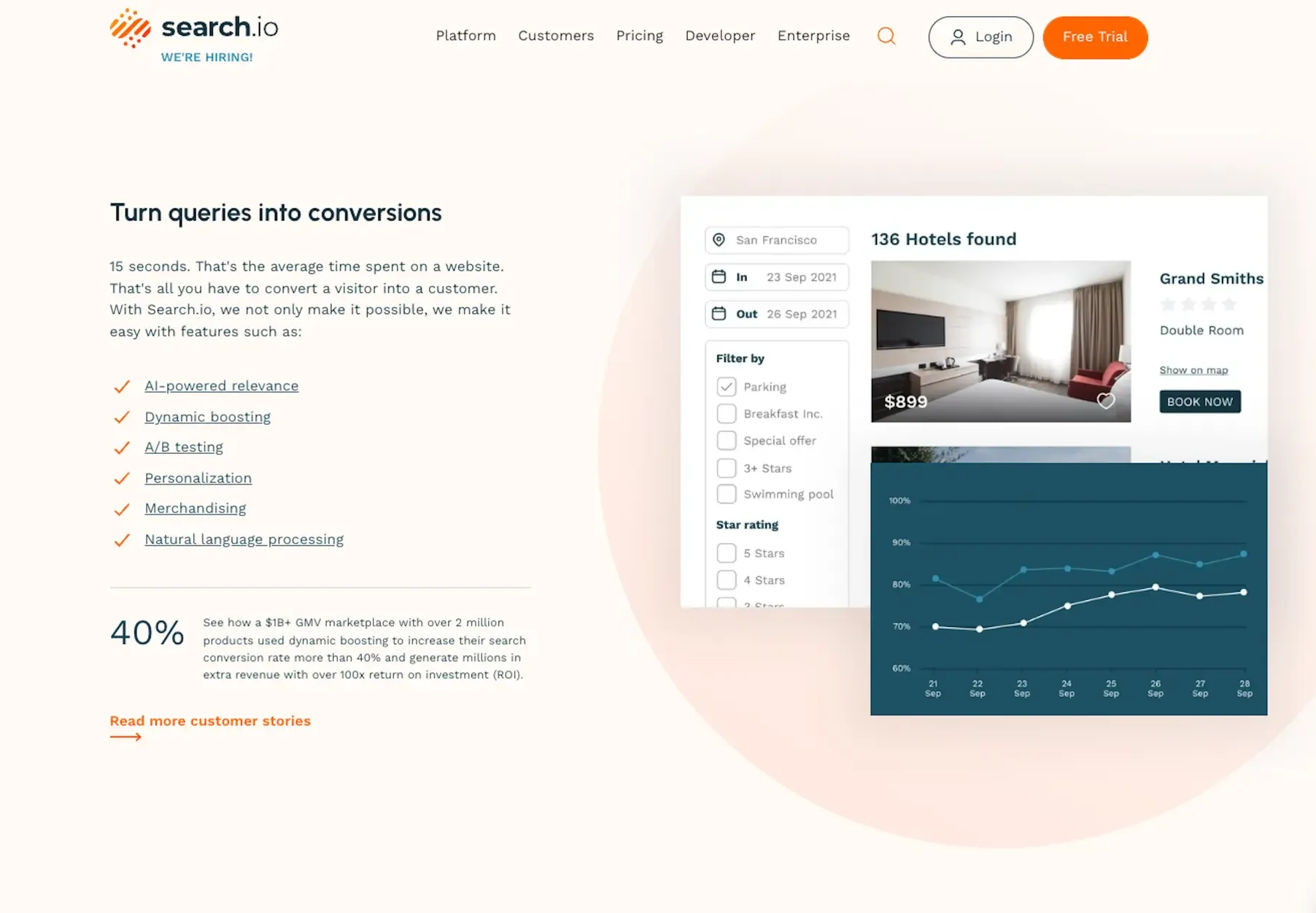
Search.io's customers were betting their conversion rate on a third-party engine, so the brief we kept hearing was reliability over feature velocity. We picked React with TypeScript to keep interfaces predictable, Redux to hold the complex configuration state the console exposed, and a custom component library so the dashboard, SDK examples, and docs all looked like the same product. Docusaurus carried the developer guides, and unit and integration tests carried the rest — the kind of quality bar that lets a search vendor get past procurement at a large retailer.
What started as a single integration for Shopify turned into Search.io's most important open-source library once the modular architecture made it clear the same components could power any storefront. We built it as a flexible library developers could customise, wrote example-driven documentation, kept the API stable across UI frameworks, and held the line on automated coverage. That SDK plus the platform plugins around it gave Search.io a credible path into stores with limited developer capacity — and an open-source surface area their own team could keep evolving.
“Working with the Dwarves team has been a game-changer for us. They not only understood our technical needs but also grasped the business impact of what we’re building. Their focus on quality and attention to detail helped us deliver a more powerful platform to our customers.”
A few sentences about your team and what you're building is usually enough. We reply within three working days.